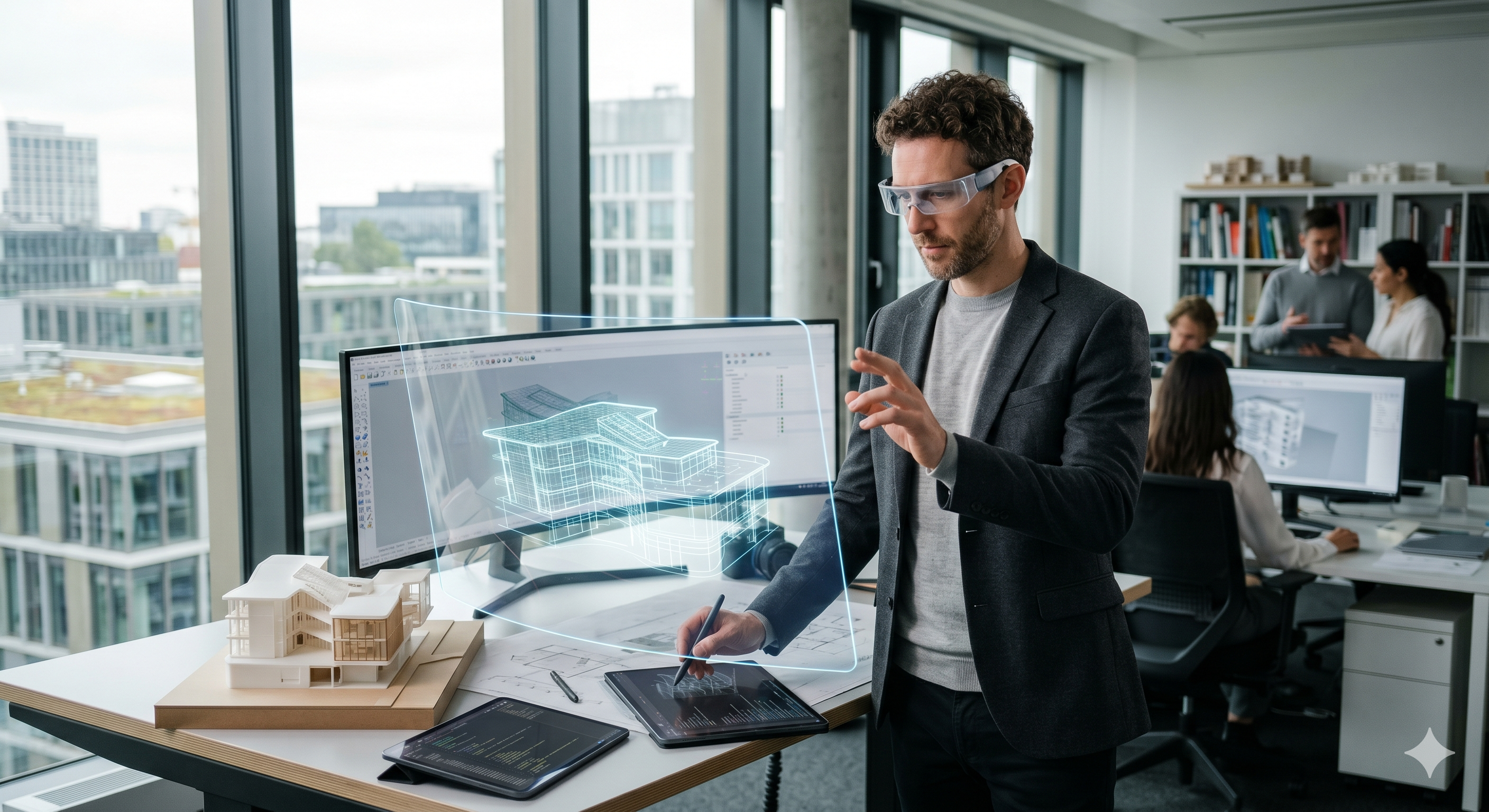
For millennia, architecture has been an act of defiance against nature. We carved stone, forged steel, and poured concrete to impose rigid, static geometries onto an untamed world. Buildings were inanimate armors—shells designed to shield us from the elements. But we are currently crossing a profound threshold. The paradigm is shifting from construction to cultivation.
We are no longer simply designing spaces; we are engineering synthetic ecosystems. At the radical intersection of biological sciences, artificial intelligence, and material engineering, the very definition of a “building” is metamorphosing from a passive container into an active, breathing organism.
Here is a deeper exploration of the frontier technologies that are rewriting the spatial DNA of our future.
1. Morphogenesis: The Algorithmic Subconscious of Design
We have moved far beyond basic Parametric Design or simple CAD tools. Today, architects are utilizing Morphogenesis—a concept borrowed directly from evolutionary biology.
Instead of imposing a preconceived form onto a site, the architect designs a system of genetic rules and environmental constraints. Generative AI then “grows” the architecture. Through processes like Topological Optimization, algorithms shave away every microscopic ounce of unnecessary material, leaving behind structures that are eerily bone-like or reminiscent of vascular systems.
- The Shift: The architect acts less like a sculptor and more like a geneticist. We are relinquishing absolute control to computational forces that can solve spatial and structural equations far beyond human cognitive capacity, resulting in spaces that are radically efficient and structurally unprecedented.
2. Engineered Living Materials (ELMs): The Metabolic Building
The era of extracting dead materials from the earth is reaching its absolute limit. The vanguard of architectural innovation is rooted in Bio-fabrication—growing our buildings using living organisms.
- Mycelium Architecture: Mycelium, the root network of fungi, is being engineered into structural bricks and insulation panels. By feeding agricultural waste to mycelium strains, we can “grow” building components in a matter of days. These materials are fire-resistant, highly insulative, and structurally robust. More importantly, they represent a true closed-loop ecology: at the end of the building’s lifecycle, the walls can simply be composted back into the soil.
- Bio-receptive and Metabolic Skins: Facades are being developed not to repel nature, but to host it. Researchers are creating bio-receptive concrete that actively encourages the growth of specific carbon-absorbing mosses and lichens without compromising structural integrity. Buildings are evolving to have their own metabolism—sequestering carbon, harvesting water, and producing biomass.
3. Programmable Matter and 4D Printing: Architecture in Motion
While 3D printing revolutionized construction logistics, the true frontier is 4D Printing, where the fourth dimension is time.
- Self-Actuating Materials: Engineers are developing programmable matter that changes its shape, porosity, or structural properties in response to environmental stimuli—such as temperature fluctuations, moisture, or light—without any mechanical motors or electrical input.
- Kinetic Micro-Structures: Imagine a building pavilion made of wood composites that autonomously curls and closes its pores when it rains, and opens to allow cross-ventilation when the sun emerges, mimicking the behavior of a pinecone. This allows for entirely passive, zero-energy climate regulation driven purely by the geometry and chemical composition of the material itself.
4. Neuroarchitecture and the Sentient Environment
The integration of the Internet of Things (IoT) has historically meant turning on lights with a smartphone. The next evolution is the Sentient Space—environments equipped with pervasive spatial computing that acts as a central nervous system.
- Embodied Interaction: Through a network of ambient sensors and machine learning, the architecture begins to “read” its inhabitants. It goes beyond tracking movement; it measures physiological markers like heart rate variability, skin temperature, and even stress levels through subtle biometric feedback.
- Psychological Optimization: The building actively curates the physical environment to support the neurological state of the user. It can dynamically alter acoustics through micro-adjustments in wall panels, shift the Kelvin temperature of ambient lighting to optimize circadian rhythms, and adjust the oxygenation levels of a room to prevent cognitive fatigue. The space becomes a continuous, empathetic partner in human well-being.
The New Role of the Architect
The profound implication of these innovations is philosophical. When our buildings can heal their own fractures, compute their own structural loads, and breathe alongside us, the binary distinction between the “natural” and the “artificial” dissolves.
The architects of the near future will not be mere draftsmen of static monuments. They will be choreographers of complex, living systems—orchestrating a delicate symphony of code, biology, and human experience to create habitats that are as dynamic and resilient as nature itself.